PART 1
The bank fell silent the second the old veteran slammed the black card onto the marble counter.
Not because he yelled.
Because of the blood.
A deep cut stretched across his cheek, half-dried beneath the harsh white lights of the lobby.
His military jacket was old.
Wrinkled.
Heavy with medals nobody bothered to recognize anymore.
People stared immediately.
Not with concern.
With discomfort.
The veteran stood there breathing hard, gripping his cane tightly.
— “Check the balance.”
The young bank manager behind the counter smirked.
Clean suit.
Perfect hair.
Expensive watch.
Everything about him screamed control.
— “Sir… this bank handles high-value clients only.”
A few customers quietly laughed.
The veteran didn’t move.
Didn’t blink.
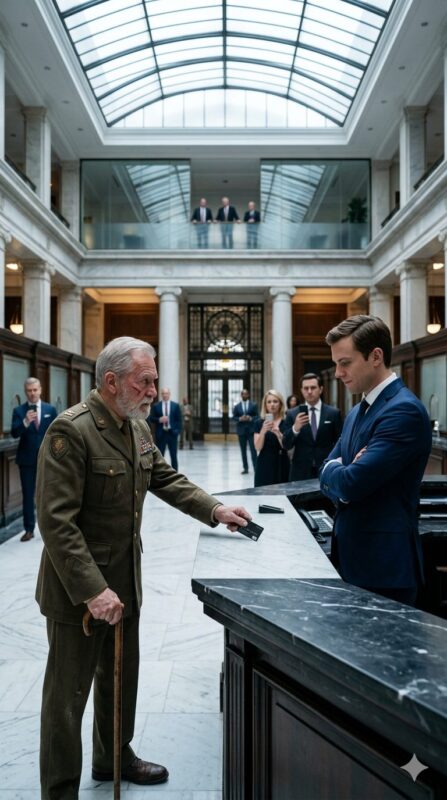 — “Check. The. Balance.”
From the upper office balcony, bank president Daniel Mercer noticed the scene and slowly walked downstairs.
Calm.
Confident.
Almost amused.
— “What seems to be the issue here?”
The manager handed him the card casually.
— “Probably another confused old man.”
Mercer smiled politely.
Then looked at the veteran.
And froze.
Because suddenly—
he recognized the face.
The scar.
The medals.
The old man standing in front of him…
was the soldier who dragged Mercer’s father out of a burning military convoy twenty-six years earlier.
The same soldier everyone believed died overseas.
PART 2 IN COMMENTS 👇👇👇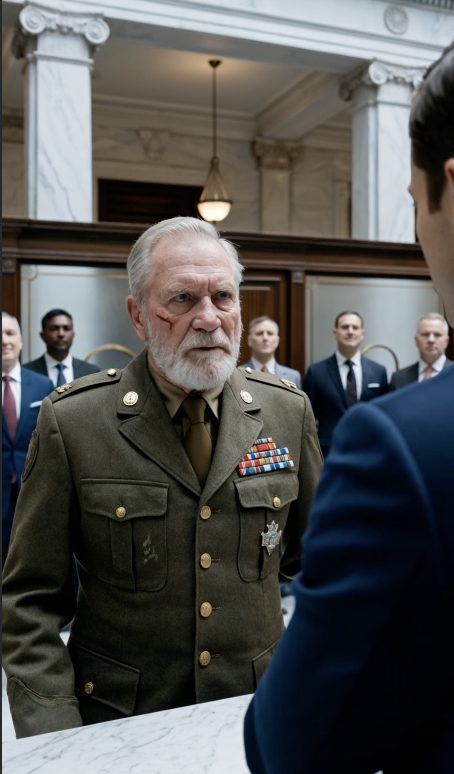
PART 2
The entire lobby watched as Daniel Mercer’s expression completely changed.
His confidence disappeared first.
Then his posture.
Then his voice.
Slowly… he looked back down at the black card in his hand.
Not ordinary.
Military private reserve access.
Restricted.
Mercer whispered:
— “This… can’t be real…”
The young manager frowned.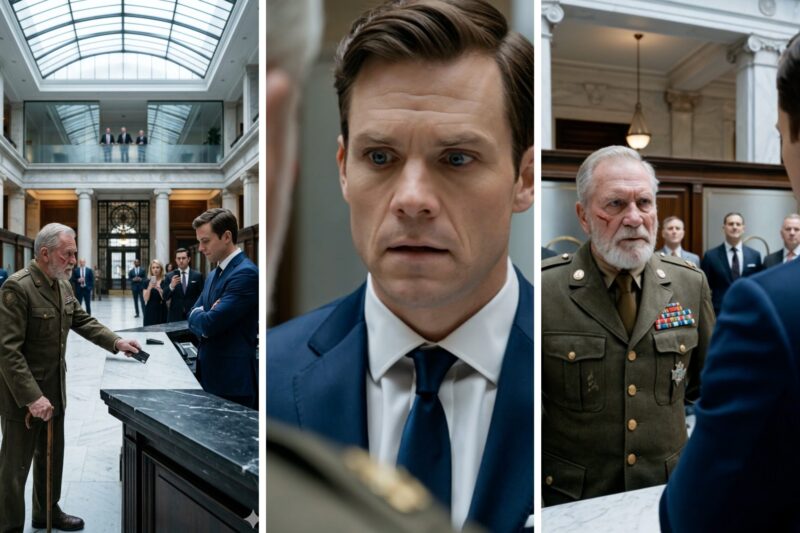
— “Sir?”
Mercer ignored him completely.
His hands were shaking now.
Because the account attached to the card wasn’t just wealthy.
It controlled one of the largest military survivor foundations in the country.
Hundreds of millions.
The old veteran watched him silently.
No anger.
No pride.
Just exhaustion.
Mercer swallowed hard.
Then quietly asked:
— “Why didn’t you tell us who you were?”
The veteran looked around the lobby.
At the phones recording him.
At the employees laughing minutes earlier.
At the customers staring.
Then answered softly:
— “Because respect shouldn’t depend on a balance.”
Nobody spoke after that.
Not one person.
And for the first time that morning—
the entire bank stood in silence for a man they almost threw out.